
Helical and push piers for Wichita foundation repair both run $1,200–$3,000 per pier — the pick is structural, not financial. Push piers drive to refusal using the house’s weight, suiting heavy basement-era masonry; helicals screw to a measured torque, suiting the slab ranches that make up half this metro.
How each proves capacity, and which Wichita housing stock calls for which.
Two proofs of the same promise
Every pier makes one promise: this point of the foundation now bears on ground below the active clay. The types differ in how they prove it. A push pier is hydraulically driven beside the footing using the structure as reaction weight until it refuses to advance — and that refusal, logged per pier, is the proof. A helical pier is a shafted screw with welded plates, rotated in by a drive head; installation torque correlates with bearing capacity, so the gauge proves the pier as it turns, no house weight required.
Side by side
| Push piers | Helical piers | |
|---|---|---|
| Drive method | Hydraulic, reacting against the structure | Rotated to a specified torque |
| Proof of capacity | Logged refusal pressure | Logged installation torque |
| Needs structure weight | Yes — that’s the engine | No |
| Wichita sweet spot | Two-story brick, older basement stock | Slab ranches, porches, additions, light frame |
| Depth here | Commonly 12–25 ft to stable strata — sections priced identically | |
| Cost | $1,200–$3,000 per pier, spread driven by depth and access | |
What Wichita’s housing mix does to the choice
This metro splits its stock, so the pier question splits with it. The slab subdivisions west and south are light — single story, frame, no basement mass — and a push pier under one may never find honest refusal because the house runs out of weight first. Helicals don’t care; they carry their proof in the torque. The older core is the opposite case: College Hill’s two-story brick has reaction weight to spare, and driving to refusal under it is as convincing as proofs get. Mixed jobs are routine — push piers under a heavy main footing, a helical under the porch that failed on its own schedule — one scope, one warranty, both logs.
Whether piers are the right repair at all is the prior question — that’s the settlement diagnosis, and slab-specific cases run through the slab repair page. Install mechanics and refusal logging live on the piering page; the arithmetic behind pier counts is in the cost guide.
What the pier warranty is actually worth
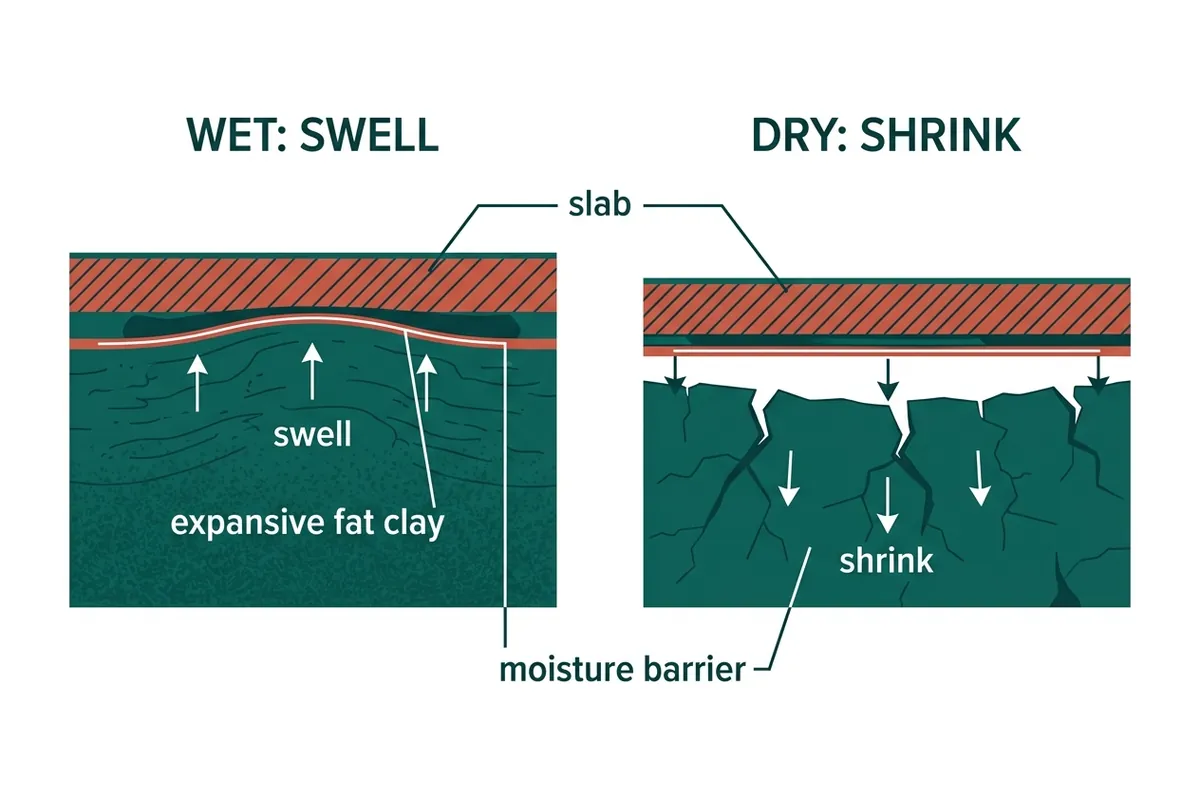
Read the warranty before the price. It covers the piers’ capacity — the supported section carrying its design load — not the whole house, and not the parts nobody piered. Four questions separate a real warranty from a brochure: is it transferable to the next owner, does the transfer cost a fee, does it cover the piered section or the structure, and does it survive the contractor closing its doors (third-party-backed warranties do). On soil that moves this much, ask whether the warranty depends on drainage or perimeter-moisture maintenance you owe — a fair clause, and the one most often discovered during a claim. Keep the depth and torque log; on fat clay, the depth the pier reached is the entire argument.
Pier questions, straight answers
Which pier costs less in Wichita?
They price the same — $1,200 to $3,000 per pier, with the spread driven by depth to stable strata and access, not by which steel goes in. A bidder pushing one type as the cheap option is describing their equipment, not your soil. What varies between them is the proof of capacity, and that's an engineering fit, not a price one.
Which type fits a slab home?
Usually helical. A single-story slab ranch doesn't weigh enough to drive a push pier to convincing refusal — the pier would push the house before the house pushed the pier. A helical torques to capacity independent of the structure above it, which makes it the honest choice for most of Wichita's slab subdivisions and for porches and stoops anywhere.
Which type fits the older basement stock?
Push piers earn their keep under weight. Two-story College Hill brick has the mass to drive a pier to genuine refusal, and that refusal — logged per pier — is a proof no torque table needs to interpret. On heavy houses both types work; on heavy houses with tight access, the push pier's more compact drive setup can also decide it.
How deep will either type go here?
To proof, not to a promised footage — commonly 12 to 25 feet across the metro before stable strata answer. Depth is the honest variable in every Wichita pier bid: more feet means more pier sections at either type. The per-pier log — final torque or refusal pressure — is your receipt that each one got where it claims.
Do both carry the same warranty?
Ours do — transferable, in writing, with the installation log attached. Keep the log with the warranty: a future buyer's inspector reading 'torque-verified' or 'refusal-logged' per pier is reading a repair that was engineered rather than estimated, and on resale that paperwork is worth real money.
Get a free Wichita foundation evaluation
Tell us what the house is doing — a crack that grew, a door that quit closing, a slab that dropped — and we'll schedule an evaluation with photos and crack measurements. We reply the same business day.